
AI + Custom Software for Supplements
Every bottle traces back to a binder somewhere.
Formulas live in a spreadsheet, ingredient lots in the ERP, supplier CoAs in an email folder, batch records in binders, and label versions on a shared drive. If you make product for brand owners, add their portals and their spec sheet formats to the pile.
Most of what slows a supplement plant down is the work of connecting those records. We build nutraceutical manufacturing software around the systems you already run: supplier CoA checks, batch and formula records tied to the right version, and orders read into the ERP, for dietary supplement and nutraceutical contract manufacturers and brands alike.
Your QA reviewer, regulatory specialist, and account manager get back the hours they spend matching documents, and they still make every release decision.

Common supplement problems
Common AI and automation opportunities in supplements & nutraceuticals
The daily problems usually sound simple: a certificate to check, a formula version to confirm, and a customer who wants it all in their own format.
Supplier CoAs & Ingredient Release
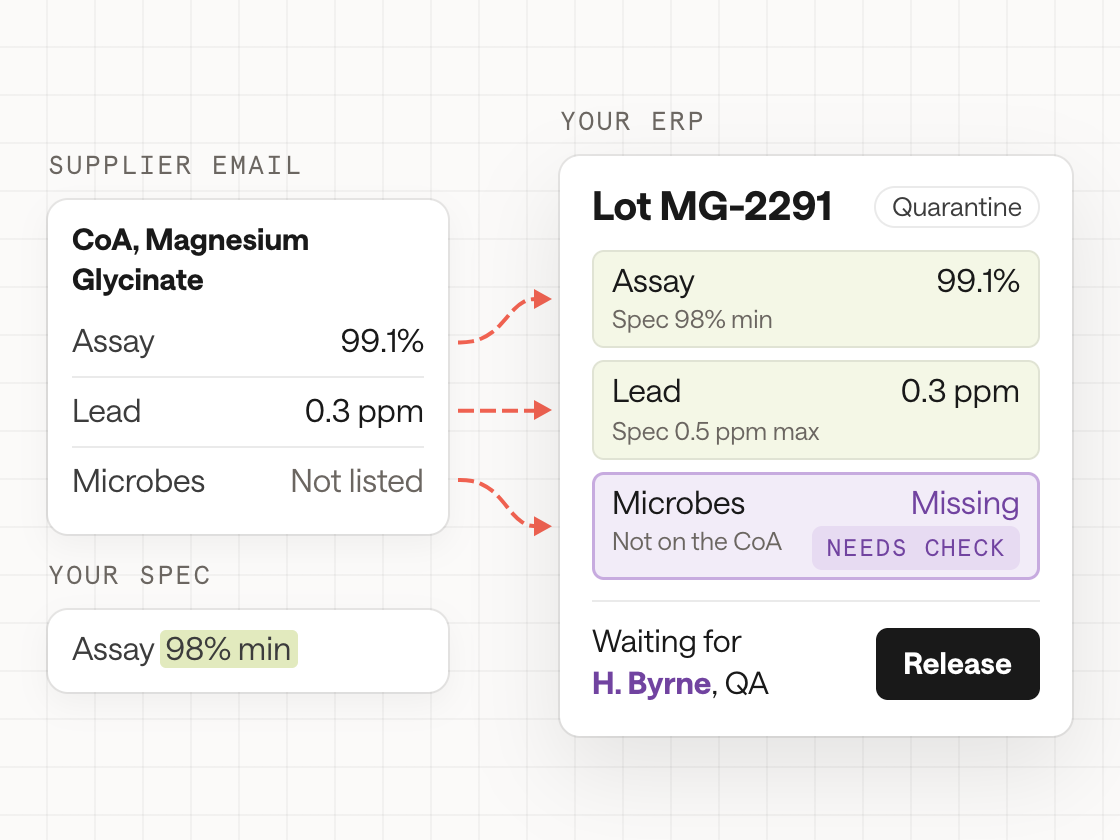
Every incoming lot needs its CoA checked against the spec.
A drum of magnesium glycinate arrives, and the supplier CoA arrives separately as an email attachment. QA opens your ingredient spec, compares assay, heavy metals, and micro limits line by line, confirms the identity test was run, logs it in a spreadsheet, and changes the lot status in the ERP. A multivitamin means doing that for every ingredient.
We build supplier CoA review that reads each certificate, compares every value against your ingredient spec and that supplier’s history, and flags only the results that are out of range or missing. Your QA reviewer decides whether the lot is released, and identity testing stays with your people.
Formulas & Batch Records
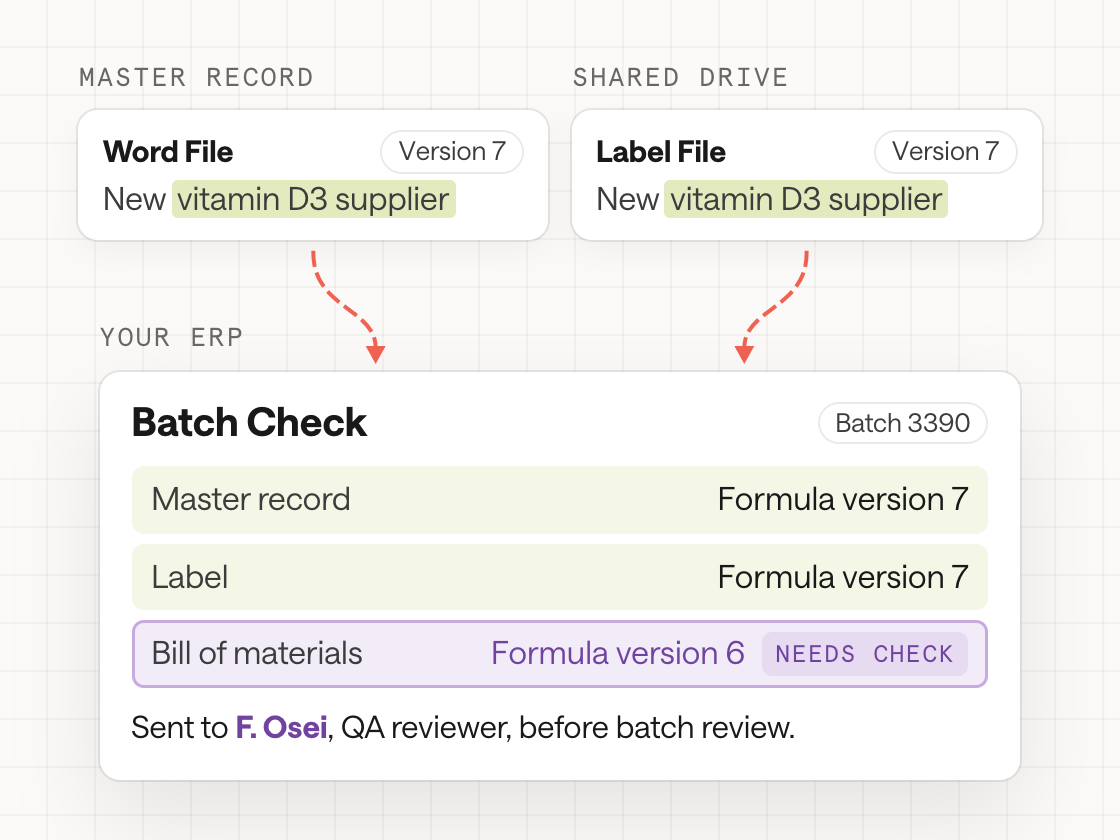
Which version of the formula did this batch use?
R&D changes a formula to swap a vitamin D3 supplier. The master manufacturing record gets a new revision in Word, the ERP bill of materials gets updated eventually, and the label file on the shared drive may or may not follow. At batch review, someone confirms by hand that everything points to the same version.
We build electronic batch record software around your procedure that ties formula versions, master manufacturing records, batch production records, and label versions together, and flags a batch weighed against an old revision before QA review begins. Your QA reviewer still reviews and approves every batch record.
Brand-Owner Orders & Documents
Every brand customer wants it in their own format.
A brand owner sends a PO as a PDF. Then they want the finished supplement CoA uploaded to their portal, a spec sheet in their template for each SKU, and status updates by email. Your account manager logs in, downloads, reformats, and uploads across several portals, answering "where’s my batch?" in between.
We build tools that read the PO into your ERP, build CoAs and spec sheets in each customer’s format from released data, and draft status updates from production and QC records.
Supplement software
Where AI and custom software fit in dietary supplement manufacturing
Supplement makers have plenty of software to choose from, and most of it arrives as one more system to log into. Our work is usually what that software leaves out: connections to the systems you already run, steps that match your SOPs as written, and documents in the formats your customers expect.
Batch, Formula, and Lot Records
Master manufacturing records, batch production records, and formula versions are built around your procedures and linked to ingredient lots, QC results, and labels. QA reviews one connected record instead of reconciling three binders, a spreadsheet, and a label file on the shared drive.
Supplier CoA Checks
Every incoming supplier CoA is read and compared against your ingredient spec and the supplier’s past results. Out-of-range values, missing tests, and expired documents surface before release, so QA spends its time on the few lots that need judgment.
Brand-Owner Documents
CoAs, spec sheets, and status updates are built from your released data in each brand owner’s format and ready for their portal. Your account manager approves each one before it goes out and gets back the mornings spent reformatting the same numbers for every customer.
Order Intake From Any Format
Brand-owner POs, distributor orders, and reorder spreadsheets are read and entered in your ERP, with SKUs, bottle counts, and ship-to addresses matched to your records. Only the exceptions reach your order desk: a new SKU, a changed label, or a quantity that looks wrong.
Ingredient Lot Lookup
"Which finished lots used this ingredient lot?" and "Which customers received them?" can be answered from one search across ERP, QC, batch, and shipping records. A supplier notice or a complaint starts with the facts, and your QA team decides what to hold and who to tell.
Answers From Your SOPs and Specs
Source-cited answers from your SOPs, specifications, and past batch records, scoped to what each person is allowed to see. A new QC tech can ask for the micro limit on the elderberry extract spec and get the answer with the exact document and section it came from.









How we work with supplement makers and brands
We start by watching the work: how an ingredient is received and released, how a batch record moves from the floor to QA, and how your account team answers a brand owner. When that’s practical we do it on site; otherwise it’s screen shares with the people who do the job. If you have SOPs, a sample MMR, or a few supplier CoAs, you can send them ahead.
Then we think it through: which steps the system can check, which need QA’s judgment, and what to build first. You see a working prototype on sample data before anything touches your ERP or quality records. Once your team approves it, we connect it to your real systems and go live, fitted to your process instead of the other way around. We work within and around the ERP and quality systems you have, such as NetSuite, DEACOM, or Business Central.
Records & control
Automation has to add to the batch record.
Batch records, specifications, and release decisions are the evidence that a product was made the way your procedures say. New tools have to add to that evidence, leave who signs for it unchanged, and keep production running while they’re built.
Work with the source of truth
Released results belong to QC. Lot status and inventory belong to the ERP. We identify which system owns each record before automating around it, so a new tool never becomes a competing version of the batch record or the spec.
QA approves and releases
AI reads, extracts, compares, and flags. Your QA reviewer approves the batch record, releases ingredients and finished product, and decides what happens to a deviation. No tool we build releases a lot or signs for anyone.
Fit your procedures as written
Your SOPs already describe how the work should happen. We build around them, step for step, instead of asking your team to adopt a vendor’s idea of a supplement plant and then rewrite your procedures to match it.
A permanent record of who signed off
Batch and release records can be traced with a permanent record system: who did what, when, and who signed off, from the supplier CoA to the finished lot. Your quality unit decides what goes into that record and who can see it.
Dietary supplement manufacturers operate under FDA’s current good manufacturing practice rule for supplements (21 CFR Part 111), which covers manufacturing, quality control, and recordkeeping, with labeling requirements on top. What applies depends on what you make and for whom. What we build supports work that your quality unit owns. Specifications, release decisions, and regulatory calls stay with them.
FAQ
Nutraceutical manufacturing software: common questions
What is 21 CFR 111?
21 CFR Part 111 is FDA’s current good manufacturing practice rule for dietary supplements. It covers how supplements are manufactured, packaged, labeled, and held, including specifications, quality control, master manufacturing records, batch production records, and complaint records. What it means for your plant is a call for your quality unit; our tools help with the records work around it.
What is a master manufacturing record?
A master manufacturing record (MMR) is the approved recipe and procedure for making one batch size of one product: ingredients and amounts, equipment, steps, specifications, and controls. Every batch production record is written against it, which is why a formula change has to reach the MMR before the next batch is made.
What is a batch production record?
A batch production record (BPR) documents how a specific batch was actually made: the ingredient lots used, weights, steps completed, in-process checks, who did each step, and QA’s review. It follows the master manufacturing record, and QA reviews it before the finished batch is released.
What should a supplier certificate of analysis include?
A useful supplier CoA names the ingredient and lot, lists each test with its method, result, and specification limit, and is dated and signed by the supplier’s quality unit. Common tests cover identity, assay or potency, heavy metals, and microbial limits. Your QA unit decides which results it relies on and which it tests itself.
Do we need new dietary supplement manufacturing software?
Usually not. Most supplement makers already have an ERP and a way to keep batch records, even if it’s paper. The hours go to the work between those systems: checking CoAs, matching formula versions, and reformatting documents. We build that connecting layer around what you already run.
Does this work for contract manufacturers and brand owners?
Yes. Contract manufacturers usually start with supplier CoAs, batch records, and brand-owner documents. Brands that outsource production usually start with incoming CoAs, spec sheets, and order status across several manufacturers. The building blocks are the same; the first project differs.
How is AI used in supplement manufacturing?
The practical uses today are in the paperwork around production: reading supplier CoAs, comparing them with specs, checking batch records against the current formula, drafting customer documents, and answering questions from SOPs with citations. People still approve every release and every record.
Can AI approve or release a batch?
No. AI can read, compare, and flag, so your QA reviewer sees the problems first. Approving a batch record, releasing a lot, and deciding what happens to a deviation stay with your quality unit.
You know AI could help. Let’s build it.
Bring us a task you have in mind, or just a hunch. We’ll help you find the right place to start and build it around the way your business works.