
AI + Custom Software for Specialty Chemical
Keep the hard part to the chemistry.
A certificate of analysis for one lot. The current safety data sheet. A technical data sheet, a regulatory letter, a purchase order that arrived as a scanned PDF. In most specialty chemical plants, the same few people answer all of it by hand, between everything else they do.
We build certificate of analysis software, SDS management, order intake, and ERP connections that answer those requests from your released results and product library, with a person approving what goes out.
Most teams start with the request that eats the most hours, usually the CoA. Your QC manager and customer service lead get their afternoons back.

Common chemical problems
Common AI and automation opportunities in specialty chemical
For most specialty chemical makers, the biggest manual job is a customer asking for a document, an order arriving in a format nobody planned for, or a lot question that takes three systems to answer.
SDS, TDS, and Regulatory Letters
The SDS is in a library, and the customer's questionnaire waits on one or two people.
Safety data sheets, technical data sheets, and TSCA, REACH, and Prop 65 statements get requested again and again, often bundled into one long customer questionnaire. The answers usually live with one or two people rather than in regulatory affairs software, so every letter waits on them.
We build SDS management, SDS request automation, and technical data sheet management on top of the library you already keep. The assistant finds the current revision, drafts the reply, and waits for a person on your regulatory team to approve it.
CoA & Customer Document Requests
The lot number arrives. Someone stops everything to build the CoA.
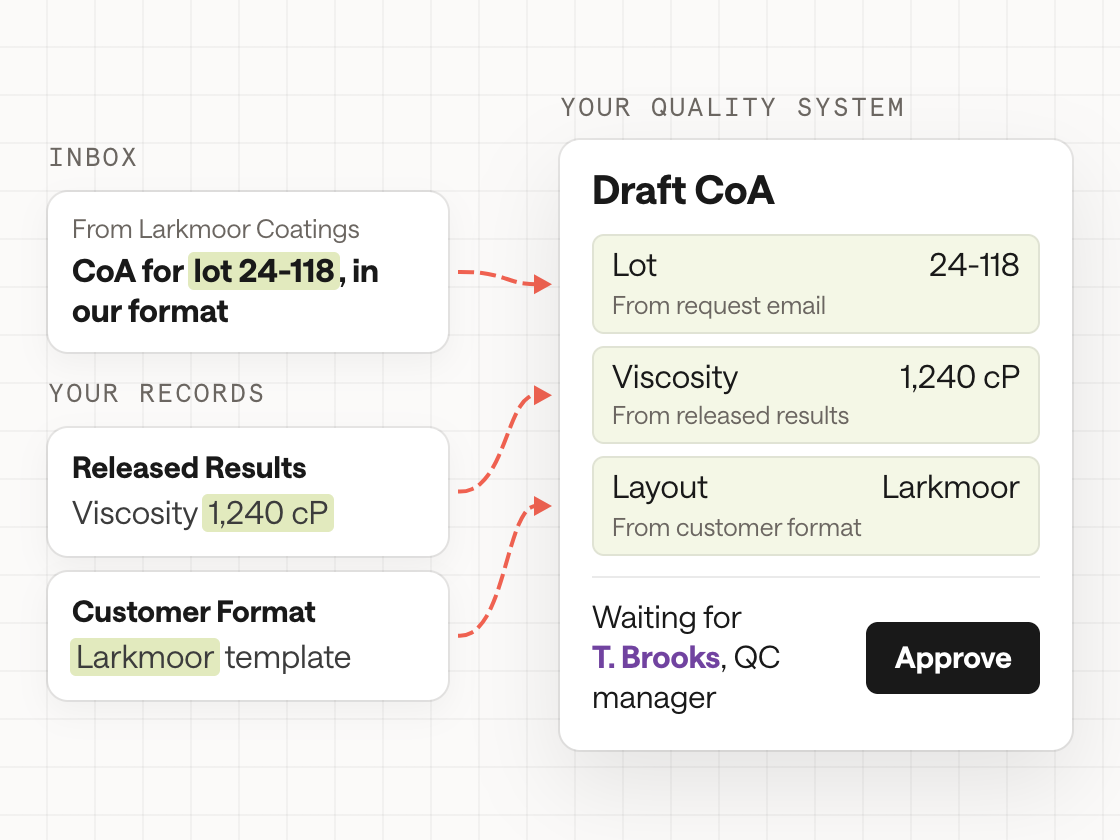
A customer emails or fills in a web form with a lot number. Someone finds the order, the lot, and the released results, then builds or attaches the certificate of analysis. The next customer wants the same lot in their own format, and the work starts again from the top.
We build CoA management, CoA request management, and certificate of analysis automation that drafts each certificate from released results in the customer’s format. Your QC manager checks it and sends it, so CoA automation saves the hours while your QC manager still reviews each certificate.
Orders, Batches, and Lot Records
The PO came in as a scan. The lot genealogy lives in a spreadsheet.
Purchase orders arrive as PDFs, spreadsheets, and typed emails, and someone retypes each one into the ERP. Batch records may still be paper, so the question "which customers got product made from this raw-material lot?" means a day of digging across ERP, QC, and shipping records.
We build order intake, batch record software, and lot traceability software around the records you already keep. Orders reach the ERP, and each lot can be traced to its batch in a permanent record system that shows who did what, when, and who signed off.
Specialty chemical software
Where AI in the chemical industry actually fits
Chemical manufacturing software and chemical industry software come down to getting the ERP, the lab, the document library, and the inbox to agree about each lot, so the best people stop keeping them in agreement by hand. AI can read, match, check, and draft. Custom software connects that work to the systems where it already happens.
Certificate of Analysis Software
CoAs built from released results in each customer’s required format, with the current SDS and TDS attached. It’s CoA software and CoA management software that fit the way you already work, with test values pulled from released results into each template.
SDS Management on the Library You Have
Your SDS files already live somewhere: a shared drive, product stewardship software, or the ERP. That stays the source. SDS management software and safety data sheet management software keep the files; we build the assistant that finds the current revision and drafts the reply.
Technical Product Search
A cited product finder for your website and sales team that searches by application, chemistry, grade, and specification as well as part number. Buyers find the right grade and its technical data sheet, and qualified requests reach your sales team with the customer’s context already attached.
Order Intake From Any Format
POs, releases, and order emails are read and set up in your ERP from PDFs, spreadsheets, portal downloads, or typed emails. Only the exceptions reach your order desk: a new ship-to, a price that doesn’t match the contract, a pack size you don’t sell.
Batch Records and Lot Traceability
Batch record software built around your master formulas, with forward and backward genealogy from raw-material receipt to the finished drum. The mock-recall question can be answered in seconds across ERP, QC, and shipping records. It’s what batch traceability software is meant to do, built on what you have.
ERP Integration and Dashboards
We connect a chemical ERP, an ERP for the chemical industry, or a general one to the lab, the document library, and the inbox through APIs and controlled data flows. Orders, inventory, and open requests show on one screen, so nobody opens five systems to answer one question.


How we work with specialty chemical manufacturers
We start by watching the work: time on the floor and at the QC bench when that’s practical, or a screen share with the person who builds the CoAs when it isn’t. If you have SOPs, sample batch records, or a stack of customer requests, you can send them ahead. Then we think it through before anything gets built: which steps the system can take, which need a person, and what to build first.
You see a working prototype on sample data before anything touches your ERP or lab system. Once your team approves it, we connect it to your real systems and it goes live. Those systems stay in place, whether that’s NetSuite, Sage X3, or a QC spreadsheet, because we work within and around what’s already running. We plan for the operators, QC staff, and customer service team who will use it, because that’s where projects like this usually stall.
Records & control
Automation still has to respect the batch record.
Every lot has a history that customers, auditors, and your own QA team may need to reconstruct years from now. We design new workflows around that history, the systems that own it, and the people who sign for it, instead of treating records as cleanup after the build.
Work with the source of truth
Released results live in the LIMS. Inventory and lot status live in the ERP. We identify which system owns each record before automating around it, so a new tool never becomes a second, conflicting copy of the lot.
People approve and release
AI reads, extracts, reconciles, checks, and drafts. Your QA reviewer releases the batch, your QC manager approves the CoA, and your customer service lead decides what goes out. Each approval records who made it and when.
Build around the plant you have
A process plant can’t stop for a software project. We connect to the ERP and lab systems already in place, in stages, so the reactor schedule, the QC bench, and the shipping dock never wait on the build.
Designed around your quality system
We design around your quality system, your SOPs, and the records your auditors ask for: who did what, to which lot, when, with which inputs, and under which procedure. Traceability is operating infrastructure.
Depending on chemistry and end market, chemical manufacturers may answer to EPA, OSHA, and DOT requirements, customer quality agreements, ISO systems, and, for products entering FDA-regulated supply chains, GMP-style documentation expectations. Your quality and regulatory team owns those requirements. Where your products feed an FDA-regulated supply chain, a domain expert joins before we promise a production system.
FAQ
Specialty chemical software: common questions
What is a certificate of analysis?
A certificate of analysis (CoA) is the document that shows a specific lot met its specification. It lists the tests run, the specification limits, and the actual results, and someone in quality signs it. Customers ask for one with almost every shipment, often in their own format, which is why CoA requests take up so much of a chemical team’s week.
What is a CoA in manufacturing?
In manufacturing, a CoA ties a finished lot to its test results. In specialty chemicals it usually covers properties such as assay, viscosity, moisture, or color, measured against the grade’s specification. Each lot gets its own CoA, so a customer who buys the same product every month still needs a new one with every shipment. That repetition is why CoA automation is usually the first thing worth building.
How do you create a certificate of analysis?
Here is how to create a certificate of analysis by hand: pull the released test results for the lot from your LIMS or QC records, place them in the customer’s template next to the specification limits, add the lot number, dates, and product details, then have quality review and sign it. Certificate of analysis software can gather the results and draft the CoA; a person still approves every one before it goes out.
What is a technical data sheet?
A technical data sheet (TDS) describes what a product is and how it performs: typical properties, recommended uses, handling, and storage. It is a sales and application document, unlike the safety data sheet, which covers hazards and safe handling. Customers and sales reps ask TDS questions all day, so an assistant that answers from your technical data sheets saves real hours.
Do we need new CoA management software or SDS management software?
Usually not. If your SDS files live in a document library, product stewardship tool or your ERP, they stay there, and so do your CoA templates. We build the layer that reads from what you have and answers the request. It is usually faster to put to work than safety data sheet software or an ERP replacement.
How is AI used in the chemical industry?
Most practical uses of AI in the chemical industry today are in the paperwork around the chemistry: answering document requests, reading purchase orders, searching technical data, and pulling reports from the ERP. AI reads and drafts; your people check and approve. That is where we start, with the request that eats the most hours of your team’s week.
Does this work for chemical distributors?
Yes. Distributors field the same requests as manufacturers, often more of them: CoAs and SDSs passed through from many suppliers, plus orders in every format. The assistant works with chemical distribution software or a general ERP, reads from the records you keep, and drafts the answer for a person on your team to approve.
You know AI could help. Let’s build it.
Bring us a task you have in mind, or just a hunch. We’ll help you find the right place to start and build it around the way your business works.