
AI + Custom Software for Laboratories
More time at the bench and less time retyping results.
Custody forms wait to be logged, instrument exports get pasted into the same workbook every batch, and an inbox fills with "are my results ready?" Most testing and analytical labs lose hours a day to the work around the LIMS.
That surrounding work is where lab workflow automation pays off. We build laboratory workflow automation that turns custody forms into proposed logins, lands instrument exports on the right samples and drafts reports for an analyst to approve, for environmental, analytical, and veterinary diagnostic labs.
Your LIMS stays the system of record. The receiving tech, the analyst, and the project manager get their hours back.

Common lab problems
Common AI and automation opportunities in laboratories
A lab’s slowest steps are the logging, copying, checking, and answering that happen before a sample reaches the instrument and after the result comes off it.
Sample Intake & Chain of Custody
The cooler is here. Logging it shouldn't take the morning.
A cooler arrives with 14 bottles and a handwritten custody form. Your receiving tech checks the temperature, counts containers, then types client, project, sample IDs, collection times, matrices, and methods into the LIMS. The relinquished-by signature is missing, so someone emails the client while hold times run.
We build lab sample intake automation and chain of custody software that reads the form from a photo or PDF, matches it to the client’s project and proposes the LIMS login with methods assigned. The tech confirms what’s in the cooler, so lab sample tracking starts at the receiving bench.
Instrument Data & Reports
The instrument did its part. Then someone pasted it into Excel.
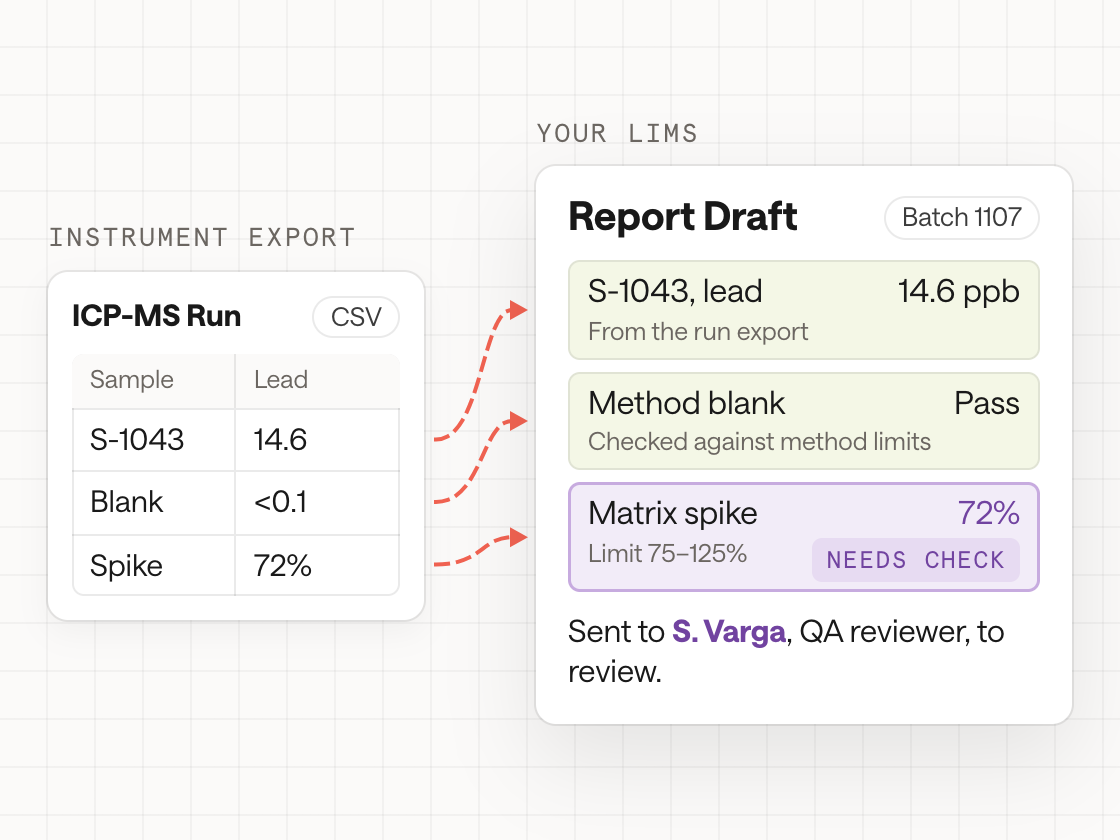
The ICP-MS run finishes and writes a CSV. The analyst pastes it into the batch workbook, checks the method blank, LCS, and matrix spike recoveries against limits, re-keys final values into the LIMS, then writes the case narrative by hand, one qualifier at a time.
We build lab data automation and lab results reporting automation that map each value to its sample, check QC against your method limits and draft the report with every flag visible, whether it’s a case narrative or a CoA lab report.
Turnaround & Client Requests
"Where are my results?" Six times before lunch.
A consultant emails asking whether Tuesday’s rush samples will make Thursday’s deadline. A veterinary clinic calls about a serology panel. Your project manager opens the LIMS, checks the open-batch spreadsheet, walks to the bench to ask an analyst, then writes back. Repeat all morning.
We build request assistants and turnaround dashboards that read incoming requests, look up status in the LIMS and the batch schedule, and draft a reply with what’s done, what’s pending, and the expected date. Your project manager approves it, and risky rush requests get flagged first.
Lab software
Where laboratory data management actually needs help
The work around the LIMS and lab management software is what needs to stop depending on retyping, copying, and memory. Laboratory software already holds the result; the hours go to getting it in and getting it out. AI lab automation can read, map, check, and draft, and each piece is built on sample data first and connected to your LIMS only after your team approves it.
Sample Management Software That Works With Your LIMS
Custody forms, submission sheets, and emailed sample lists become proposed LIMS logins with methods, hold times, and containers already checked. This lab sample management software reads what already arrives, which is what sample tracking software should do.
Instrument Import and QC Checks
Exports from ICP, GC-MS, LC-MS, and plate readers map to the right samples without a paste step. Blanks, spikes, and duplicates are checked against your method limits, and only out-of-range rows reach the analyst. It’s lab data management software for the step between instrument and LIMS.
Environmental and Analytical Labs
Environmental testing lab software has to handle hold times, preservatives, and method codes on every bottle. Analytical lab software has to handle instruments that each export a different file. We build testing lab software and testing laboratory software for the lab you run.
Veterinary Diagnostic Labs
Submission forms arrive with an animal, an owner, a clinic, and a panel request, often handwritten. We build accessioning that links each specimen to the animal and the practice, routes the tests, and sends reports back to the clinic once your pathologist or lab director approves them.
Bench Sheets, Logbooks, and Lab Documents
Prep logs, balance checks, refrigerator temperature sheets, and digestion logs often stay on paper for good reasons. A phone photo turns each page into structured data tied to the right batch, and laboratory document management means finding that page later without opening a binder.
Billing and Turnaround Reporting
Invoices built from LIMS exports miss rush charges, subcontracted tests, and reruns. We reconcile what was run against what was quoted and billed, and give you turnaround, backlog, and workload reports from lab software that already holds the data, instead of another spreadsheet.



How we work with laboratories
We start at the receiving bench. If it helps, you gather a few redacted custody forms, instrument exports, and a finished report. Then we watch the work: login, prep, the instrument run, review, the report going out, and the invoice after it.
Then we think it through: which steps can be automated, which need an analyst’s judgment, and what should be built first. You see a working prototype on sample data before anything touches your LIMS. Once your team approves it, we connect it to your real systems and go live. Your LIMS and instrument software, including Agilent OpenLab and Waters Empower, stay where they are; we work within and around them.
Results & control
Faster reporting still has to keep the chain of custody intact.
A lab result is only as good as the history behind it. Anything we build has to preserve who received, prepared, ran, and reviewed each sample, and when. A faster workflow that weakens that record is one your lab can’t use.
The LIMS stays the system of record
We read from and write to your LIMS under the permissions it already enforces. A new intake screen or report workflow should never become a second, competing copy of the sample, the result, or the custody record.
Analysts approve every result
The system imports, checks, flags, and drafts. Final analytical approval stays with the analyst, and QA review stays with QA. Each approval is recorded with the person, the time, and what they were looking at.
Every automated step leaves a trail
When the system proposes a method assignment or a QC qualifier, the proposal, the source data, and the person who accepted or changed it are kept together, so anyone reconstructing the result can see what happened.
Designed around your quality manual
We design around your quality manual, your SOPs, and the records your assessors ask for, so pulling the full history of one result, from the cooler to the signed report, is a search instead of an afternoon in binders.
Environmental labs often operate under state accreditation programs and standards influenced by NELAC/TNI, EPA methods and program-specific requirements, and ISO/IEC 17025 is a major competence standard across testing and calibration labs. What we build supports your accreditation and compliance work, which your QA officer and lab director still own. Method changes, new accreditation scopes, and assessor findings stay their call; the software follows them.
FAQ
Lab workflow automation: common questions
What is lab automation?
Lab automation usually means one of two things. Physical lab automation uses robots, liquid handlers, and schedulers to move samples. Lab automation software for the paperwork handles what happens around the bench: logging samples, importing instrument data, checking QC, and drafting reports. Much of what’s sold as laboratory automation software focuses on the first. We work on the second, with an analyst approving every result.
Is this a LIMS?
No. Your LIMS stays the system of record for samples, results, and custody. We build lab workflow automation around it: intake that proposes logins, imports that map instrument data, and drafts that wait for approval. It reads from and writes to your LIMS under the permissions it already enforces, so there’s never a second copy of the result.
What lab software do you work with?
Most labs run a LIMS, instrument software, Excel, a shared inbox, and a billing system, and the mix differs from lab to lab. We work within and around the lab software you already have; the platforms named above are common examples. The first step is watching how samples and data actually move through your lab.
Can you draft lab reports for us?
Yes, as drafts. Lab report software built this way maps instrument values to samples, checks QC against your method limits and drafts the report or case narrative with every flag and qualifier visible. The analyst edits and approves it, and nothing reaches a client until they do.
Does a person still approve every result?
Yes. The system imports, checks, flags, and drafts. Final analytical approval stays with the analyst, QA review stays with QA, and nothing reaches a client without that approval. Each approval is recorded with the person, the time, and what they were looking at, so anyone reconstructing the result later can see what happened.
Can chain of custody software read handwritten custody forms?
Yes, from a photo or a PDF. It reads the client, project, sample IDs, collection times, matrices, and requested methods, matches them to the client’s project, and proposes the LIMS login with methods assigned. Gaps such as a missing relinquished-by signature are flagged right away, so someone can contact the client while hold times are still running. The receiving tech confirms what’s actually in the cooler before anything is logged.
How can a lab answer "are my results ready?" without pulling analysts off the bench?
A request assistant reads each incoming email, finds the samples, and looks up their status in the LIMS and the batch schedule. It drafts a reply with what’s done, what’s pending, and the expected date, and your project manager approves it before it goes out. Risky rush requests are flagged first. Analysts stay at the bench instead of fielding the same status question all morning.
You know AI could help. Let’s build it.
Bring us a task you have in mind, or just a hunch. We’ll help you find the right place to start and build it around the way your business works.