
AI + Custom Software for Food & Beverage
Know where every lot went before the phone rings.
A supplier calls about a recalled ingredient. A retailer wants the spec sheet and allergen statement again. A distributor PO arrives as a PDF. In most food and beverage plants, the answers exist across the ERP, the receiving log, and a QA binder, and someone pieces them together by hand.
Our work starts with that piecing together. We build food traceability software, spec sheet assistants, and order entry that link receiving, production, and shipping records, so a mock recall runs in minutes and customer documents go out with the current versions attached.
Most plants begin with the question that costs the most hours: where did this lot go? Your QA manager and customer service lead get their afternoons back.

Common food & beverage problems
Common AI and automation opportunities in food & beverage
A food plant’s history is spread across the ERP, the receiving log on the dock, HACCP and sanitation checks, the production sheet on the line, and the shipping system. Each one knows something about lot 0612-B. None of them can answer a recall question by itself.
Spec Sheets, CoAs, and Allergen Statements
Can you send the spec sheet and the allergen statement again?
Every distributor, retailer, and co-packing customer asks for the same documents in a different format: a food spec sheet, an ingredient specification sheet, a nutrition panel, a CoA for one lot, a letter of guarantee. Customer service builds each packet from a shared drive and answers every allergen statement request hoping the version is current.
We build spec sheet software and customer-document assistants that read your specs, CoAs, and supplier documents and draft the reply with the current versions attached, in each customer’s format. A person on your team approves anything that leaves the building.
Traceability & Mock Recalls
A mock recall shouldn't take all day.
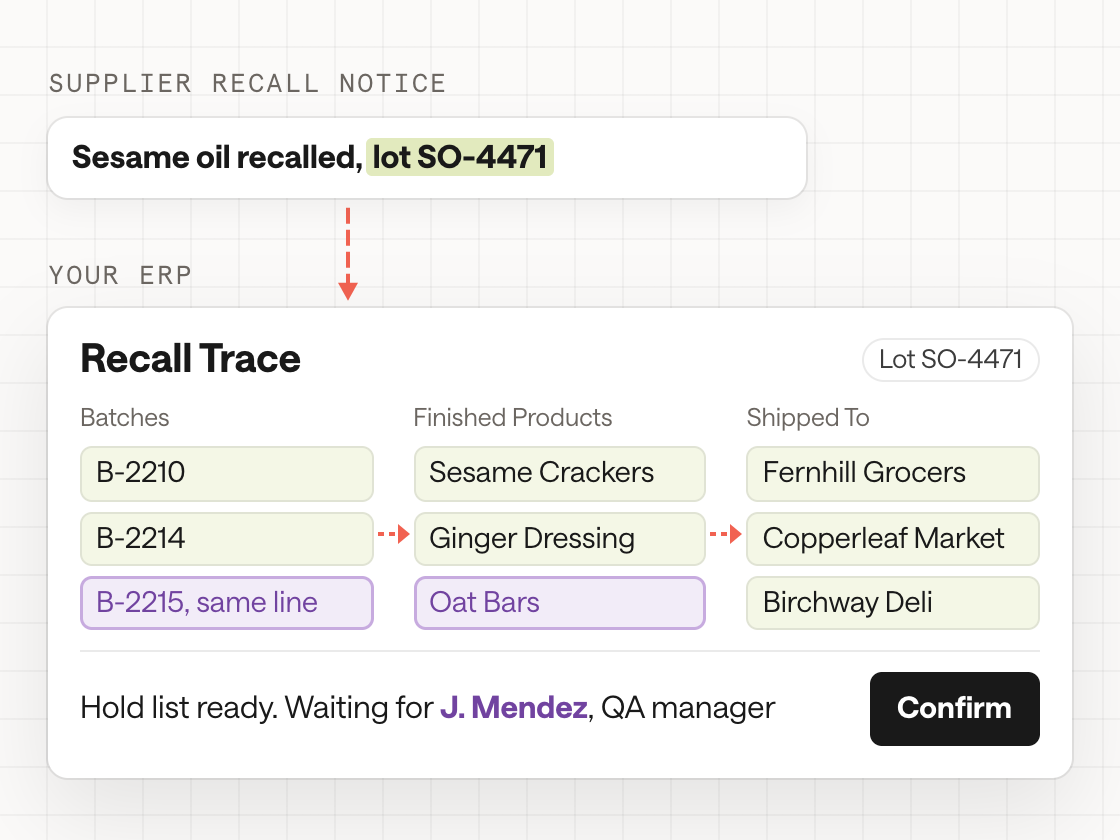
A supplier calls about a lot of sesame paste. Your QA manager finds the receiving log, reads the supplier lot code off a scanned bill of lading, searches production sheets for runs that used it, matches them to finished-goods lots in the ERP and asks shipping for every order. Hours later, nobody is sure the list is complete.
We build food traceability and recall management software that starts from the records you already keep. Receiving, production, and shipping records are linked as they’re made, so one step back and one step forward becomes a search. Your QA manager reviews the result and decides what to hold and who to call.
Receiving Records & Order Entry
We write the same lot code down four times.
A pallet arrives. The receiver writes the supplier lot on a paper log, QA checks the supplier’s CoA against the spec, someone types the lot into the ERP, and production writes it again on the batch sheet. Every copy is a chance for a transposed digit, and the food safety records you need later end up in four places.
We build paper-to-data capture and order entry automation for food and beverage plants. A phone photo of a label, bill of lading, or temperature sheet becomes food safety documentation tied to the lot, and distributor POs land in your ERP.
Food & beverage software
Food traceability and FSMA 204: where AI actually fits
Food and beverage software works best as a layer on top of the ERP the plant already runs. Most of the useful AI in food and beverage today sits in the paperwork: what connects the dock, the line, the QA office, and the shipping desk, so the records agree and nobody reconciles them at the end of every shift. Linked lot records are also what FSMA 204 describes, so the daily benefit and the preparation work point the same way.
Food Traceability Software for Recall Lookups
"Where did this ingredient go?" and "What went into this lot?" answered in seconds across ERP, QA, production, and shipping records. A customer complaint, a supplier notice, and a mock recall all start from the same search. It’s food recall software built on the records you have.
Product Specification Management Software on Your Existing Files
Your specs already live somewhere: a PLM tool, a shared drive, a supplier portal. That stays the source. Specification management software keeps the files; we build the assistant that finds the current version when a customer asks and drafts the reply.
Receiving and Floor Records From Paper
Receiving logs, temperature sheets, and sanitation checklists can stay on paper where your crew prefers it. A phone photo turns each one into structured data tied to the lot, the line, and the shift. It’s food safety documentation software built around the clipboard your crew already uses every day.
Batch and Production Records
Production records built around your actual process: ingredient lots consumed, steps, yields, and the finished-goods lots that come out, each linked back to receiving and forward to shipping. Beverage plants get the same chain for blends and bottling runs.
Orders Into Your ERP
Distributor POs, retailer portal releases, and emailed orders are read, matched to your item numbers, case packs, and ship-to addresses, and set up for a person to approve. This works with a food and beverage ERP or an ERP for food manufacturing, and only the exceptions reach your order desk.
For Food Distributors
Distributors field the same questions with less control over the source: spec sheets, CoAs, and allergen statements from dozens of suppliers, plus orders in every customer format. The assistant works with food distribution software or a general ERP and drafts the answer.



How we work with food & beverage manufacturers
We start by watching the work, dock to dock. That can mean walking receiving, the line, and the QA office with the people who keep the records, or sitting with your QA manager while they run a mock recall the way they do it today. If you have sample receiving logs, production sheets, or your last recall exercise, you can send them ahead. Then we think it through: which steps the system can take, which need a person, and what to build first.
You see a working prototype on sample data before anything touches your ERP or QA system. Once your team approves it, we connect it to your real systems and it goes live, scheduled around production rather than over it. We work within and around the ERP you already run, whether that’s NetSuite, Sage X3, or QuickBooks, rather than asking the plant to switch.
Food safety & control
Automation still has to respect the food safety plan.
Your food safety plan, your preventive-control records, and your lot codes exist so you can show what happened to every ingredient. New tools have to add to that history cleanly and keep the line running while they’re built.
Work with the source of truth
Lot status lives in the ERP, food safety checks live in QA, and shipments live in the shipping system. We identify which system owns each record before automating around it, so traceability never depends on a second, conflicting copy.
People approve and release
AI reads, extracts, links, and flags. Your QA manager releases ingredients and finished goods, decides what goes on hold, and decides who gets called. Every approval keeps a record of who made it and when it was made.
Fit the way the floor works
Receivers, line leads, and sanitation crews already have a routine. We build around it, keeping paper where paper works, capturing from a phone where it helps, and adding screens only when they save someone real time.
Traceability as a daily benefit first
The lot links that answer a customer complaint in minutes are the same ones FDA’s Food Traceability Rule describes. We build for the daily benefit first, around your food safety plan and the records your auditors ask for.
FDA’s Food Traceability Rule under FSMA asks covered entities handling foods on the Food Traceability List to keep Key Data Elements tied to Critical Tracking Events and, when required, to provide that information to FDA within 24 hours. In 2026, enforcement was directed not to begin before July 20, 2028. Your food safety and quality team decides whether the rule covers your products.
FAQ
Food traceability software: common questions
What is food traceability?
Food traceability is the ability to follow a product one step back and one step forward: which supplier lots went into a finished lot, and which customers received it. It depends on lot codes recorded at receiving, production, and shipping. When those records are linked, a recall or a customer complaint becomes a search.
What is FSMA 204?
FSMA 204 is the FDA’s Food Traceability Rule, from Section 204 of the Food Safety Modernization Act. It asks companies that handle foods on the Food Traceability List to keep Key Data Elements for Critical Tracking Events, such as receiving, transformation, and shipping, and to provide them to FDA within 24 hours when asked. Enforcement is directed not to begin before July 20, 2028. Whether it covers your products is a call for your food safety team.
Do we need new food traceability software, or a new ERP?
Usually not. Your lot codes already live in the ERP, the receiving log, and the shipping system. We build the layer that links them and answers the question, so a mock recall runs from one search. It is usually faster to put to work than food and beverage manufacturing software or an ERP replacement.
What does AI in food manufacturing actually do?
Most practical uses of AI in food manufacturing today are in the records around the food: reading receiving paperwork and supplier CoAs, linking lot codes, answering spec sheet requests, and entering orders. AI reads, links, and drafts; your QA manager and customer service team check and approve. Nothing is released, held, or sent to a customer without a person deciding.
Can you answer spec sheet and allergen requests for us?
Yes, with a person approving each reply. The assistant reads your current spec sheets, ingredient specification sheets, allergen statements, and CoAs, finds the right version for the product or lot the customer named, and drafts the reply in their format. Customer service checks it and sends it.
What happens when a supplier calls about a recalled ingredient?
Today that call usually starts a long hunt through receiving logs, production sheets, and shipping records. With recall management software built on the records you already keep, the search runs from the supplier lot code to the production runs that used it, the finished-goods lots that came out, and the customers who received them, with the source record behind each link. Your QA manager reviews the list and decides what to hold and who to call.
Can receiving logs and temperature sheets stay on paper?
Yes. Receivers and line crews keep the clipboards they know. A phone photo of a receiving log, temperature sheet, or sanitation checklist turns each page into structured data tied to the lot, the line, and the shift, so the supplier lot code is written once. Your food safety records become searchable, and anything hard to read or out of range goes to a person to confirm before it’s saved.
You know AI could help. Let’s build it.
Bring us a task you have in mind, or just a hunch. We’ll help you find the right place to start and build it around the way your business works.