
AI + Custom Software for Engineering & Construction
Build more, search less, and keep projects moving.
Project decisions in engineering and construction depend on drawings, specifications, RFIs, submittals, schedules, contracts, estimates, field reports, project systems, and decades of accumulated technical knowledge.
Think It First builds AI solutions for construction, custom engineering and construction software, workflow automation, project search, system integrations, dashboards, and digital tools that help teams find information faster, reduce repetitive project administration, connect fragmented systems, and spend more of their time designing, coordinating, and building. For organizations exploring AI for engineering firms or construction teams, the opportunity is often in improving the project work already happening.
The goal is a faster path from information to action, using the software, data, and expertise your organization already has.

Common project problems
Common AI and automation opportunities in engineering & construction
Project technology can be sophisticated while the daily work around it is still surprisingly manual.
Project Knowledge & AI Search
Stop searching five systems for an answer you still have to verify.
Project teams may know the answer exists somewhere (in a drawing set, specification, RFI, submittal, contract, prior project, technical standard, SharePoint folder, or project-management platform) but still spend valuable time finding the right version and confirming that it applies.
We build AI project search, engineering document search, construction document search, engineering knowledge management, and construction knowledge management systems around approved project sources. Retrieval can respect project permissions and document revisions, return links or citations to supporting material, and help people verify the answer before they act on it. The same foundation can improve engineering document management and construction document management inside the repositories they already use.
Estimating, Bidding, and Project Intelligence
Use what you already know to pursue and deliver better work.
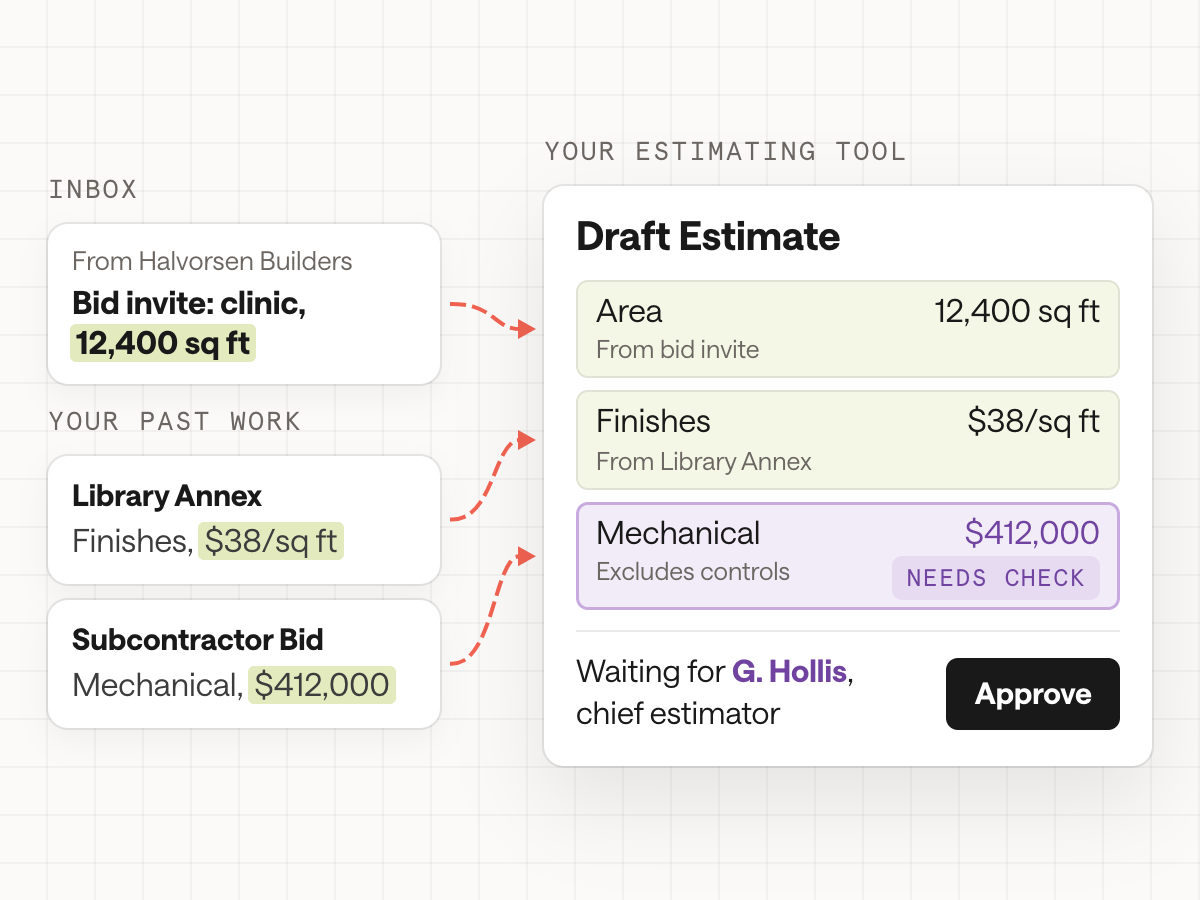
Estimating and preconstruction teams repeatedly combine scope, drawings, specifications, historical costs, subcontractor bids, assumptions, exclusions, schedules, and internal experience before a project can move forward.
We can build construction estimating automation, bid management automation, construction project intelligence, engineering project intelligence, proposal workflows, and historical-project search that make prior information easier to reuse, surface gaps earlier, and reduce repetitive comparison work. Better access to project and cost knowledge can help teams move faster on opportunities while keeping experienced people focused on the judgment that affects margin.
RFI, Submittal, and Document Automation
Let AI assemble the project context before somebody has to make the call.
Creating or reviewing an RFI, submittal, change, daily log, or other project record can require cross-checking drawings, specifications, contracts, schedules, prior correspondence, field notes, and internal standards.
Construction document automation, RFI automation, submittal automation, engineering workflow automation, and construction workflow automation can classify incoming information, retrieve relevant project context, compare requirements, pre-populate structured records, flag missing information or conflicts, and prepare a draft for human review.
AEC digital transformation
Where AI and custom software fit in engineering & construction
AI can accelerate project work inside the platforms teams already use. The opportunity is often to make drawings, documents, project data, field information, and existing software work together, so engineers spend their time on design, coordination, problem-solving, and delivery.
AI Project Knowledge & Document Intelligence
Engineering and construction knowledge is distributed across drawings, specifications, calculations, standards, contracts, correspondence, reports, and project archives. Engineering document intelligence, construction document intelligence, semantic search, enterprise search, and source-backed knowledge systems can make that information easier to find, compare, and reuse across active and historical work.
RFI, Submittal, and Project Workflow Automation
Automate the work around RFIs, submittals, changes, daily logs, document routing, approvals, and field-to-office handoffs. Construction project management automation and AI agents can gather context, structure inputs, draft records, cross-check project documents, and surface exceptions while project managers, engineers, architects, and other responsible staff retain review and approval.
Custom Project, Field, and Client Applications
Off-the-shelf construction software cannot cover every specialized process. Our construction software development and engineering software development work can include custom construction software, engineering applications, client and owner portals, field tools, internal workflow systems, project dashboards, and mobile-friendly interfaces around the gaps that remain.
Project Data, BIM, and System Integration
Project information may span Procore, Autodesk, Bentley, SharePoint, ERP/accounting, CRM, scheduling, estimating, BIM/design, document-management, and custom systems. We build construction data integration, construction systems integration, engineering systems integration, construction API integration, engineering API integration, construction ERP integration, and engineering ERP integration where the workflow requires them, and we keep permissions, ownership, and the systems of record in place.
Estimating, Cost, Change, and Revenue Intelligence
Project profitability depends on estimates, bids, contracts, changes, and schedules working together. Custom estimating and project-control tools can connect historical costs, bids, contracts, changes, schedules, project financials, and operational data to help teams compare opportunities, spot scope or cost exposure earlier, reduce repetitive analysis, and protect the capacity of high-value staff. Construction change order automation and project financial intelligence can also reduce the lag between a project change and understanding its commercial impact.
Resource, Workforce, and Operational Intelligence
Engineering and construction firms make money by putting the right expertise, crews, equipment, and attention on the right work. Construction resource management, construction workforce management, construction dashboard, engineering dashboard, construction operations dashboard, and engineering operations dashboard capabilities can help teams understand capacity, workload, project health, utilization, field activity, and emerging risks without rebuilding the same report from disconnected systems. For leadership, construction analytics dashboards and engineering analytics dashboards can turn the same underlying data into portfolio-level visibility.
Specialty Field Compliance & Evidence
For environmental remediation, hazardous-material work, utility contractors, and specialty inspections, the paperwork is part of the job. Site inspections, safety observations, training records, equipment checks, geotagged photos, corrective actions, and closeout packages get captured as the work happens, tied to the permit or contract clause that asked for them, and flagged when something is missing. Your safety lead still reviews and signs off.






How we work with engineering & construction organizations
Project environments accumulate technology because every discipline and phase has different requirements. Design teams may work in Autodesk or Bentley environments, field teams in construction-management software, finance in an ERP, business development in a CRM, and critical project knowledge across SharePoint, network drives, email, PDFs, spreadsheets, and custom systems. We work within and around that environment, from Revit and Autodesk Construction Cloud to Primavera P6 and Sage 300, so no discipline has to give up the platform its phase depends on.
So we start by watching the work. Send us a sample RFI log, a submittal package, or a stack of field forms first if that helps. For teams within traveling distance, we sit with your project engineers, estimators, and field supervisors on site, at the office, and on the job; for everyone else, we watch over a video call while they share their screens. Then we think it through: what can improve inside your current environment, what should be connected, where an engineer or project lead has to approve, and where a custom application, AI agent, retrieval layer, or dashboard fits best. You see a working prototype on sample data before anything touches Procore, ACC or your document control. Once you approve it, we connect it to your real systems and go live. Implementation is done in weeks, not months.
Reliability, permissions, and control
AI still has to work like project information matters.
Engineering and construction teams need speed, but they also work in environments where a wrong document version, missing requirement, hidden scope change, or unsupported answer can create expensive downstream consequences. New intelligence should make project information easier to use and keep the controls professionals rely on.
Work from defined sources of truth
Not every drawing, specification, model, contract, project record, or database carries the same authority. We establish which systems and document states should govern each workflow so a new search experience, dashboard, or AI agent does not quietly turn an outdated copy into the operating truth.
Make answers verifiable
When an AI system retrieves technical or project information, the user should be able to understand what supports the answer. Depending on the workflow, that can include citations, direct document links, version information, confidence or evaluation checks, and clear escalation when the available sources do not support a reliable response.
Keep experts in consequential decisions
AI can search, compare, classify, summarize, draft, and surface risk. Review and approval remain with the engineers, architects, project leaders, estimators, field teams, or other responsible professionals when decisions affect design, scope, cost, schedule, safety, contracts, or construction.
Respect permissions, projects, and revisions
Project information has boundaries. We design retrieval, agents, integrations, and applications around access controls, project separation, document status, revision history, auditability, and the existing permission model so faster access to information stays within the access the organization intended.
AI reliability depends on the underlying information architecture as much as the model. Project-specific sources, permissions, revision control, retrieval quality, evaluation, and human verification should be designed into the system rather than added after users stop trusting the answers. Where a job carries inspection, safety, or permit records, the system is built to support that compliance work, which your safety and compliance people still own.
FAQ
AI for engineering & construction: common questions
How can engineering teams search and analyze project documentation quickly?
AI project search can look across drawings, specifications, RFIs, submittals, contracts, and prior projects in the repositories you already use, such as SharePoint, Procore, Autodesk Docs, or ProjectWise. It respects project permissions and document revisions and returns links or citations to the source, so an engineer can verify the answer before acting on it. When the sources don’t support a reliable answer, the system escalates instead of guessing.
How is AI used in construction and engineering firms?
The most useful applications stay close to the project. AI can assemble context for an RFI or submittal, cross-check drawings against specifications, pre-populate daily logs, search historical costs during estimating, and flag missing closeout documentation. Each one cuts administrative time for project engineers, estimators, and field supervisors. Engineers, architects, and project leaders keep every decision that affects design, scope, cost, schedule, or safety.
Can AI automate RFIs and submittals?
It can handle much of the preparation. RFI automation and submittal automation can classify incoming information, pull the relevant drawings, specifications, and prior correspondence, compare requirements, flag conflicts or missing items, and pre-populate a draft record. A project manager, engineer, or architect still reviews and approves it. The system shortens the path to the decision, and a person makes it.
Can you connect document insights across Procore, Autodesk, and Bentley projects?
Yes. Project information usually spans Procore, Autodesk Construction Cloud, Bentley ProjectWise, SharePoint, an ERP or accounting system, scheduling, and estimating tools. We build construction systems integration and API connections around those platforms while keeping permissions, document ownership, and the authoritative system intact. Each integration is scoped to one specific problem, and nothing touches your live document control until you approve it.
Can you help with inspection, safety, and closeout documentation?
Yes, for specialty field work where the paperwork is part of the job. Site inspections, safety observations, training records, equipment checks, geotagged photos, and corrective actions can be captured as the work happens, tied to the permit or contract clause that asked for them, and flagged when something is missing. What we build supports that compliance work, which your safety and compliance people still own. Your safety lead still reviews and signs off.
How long does an engineering or construction AI project take?
Implementation is done in weeks, not months. We start by watching the work, on site with project engineers, estimators, and field supervisors when we’re within traveling distance, or over a video call. You can send a sample RFI log, a submittal package, or a stack of field forms first. Then you see a working prototype on sample data, and we connect it to your real systems once you approve it.
You know AI could help. Let’s build it.
Bring us a task you have in mind, or just a hunch. We’ll help you find the right place to start and build it around the way your business works.