
AI + Custom Software for Cosmetics
One product, five records, and none of them connected.
Formula versions sit in a spreadsheet, supplier documents in email, batch records in the ERP or on paper, and the safety file in a shared folder, while complaints arrive through the help desk, the Shopify inbox, and marketplace messages.
When a customer reports a reaction, someone has to connect the complaint to a lot, the lot to a formula version, and the formula to its safety evidence. We build cosmetic manufacturing software that keeps those records linked, so that question has a quick answer, for growing beauty and personal care brands and their contract manufacturers.
Your regulatory lead or founder gets hours back for product development and customers.

Common cosmetics problems
Common AI and automation opportunities in cosmetics & personal care
The rules are getting more detailed, and the daily problems usually sound simple: a complaint to trace, a formula change to follow through, and a brand client waiting on paperwork.
Complaints & Adverse Events
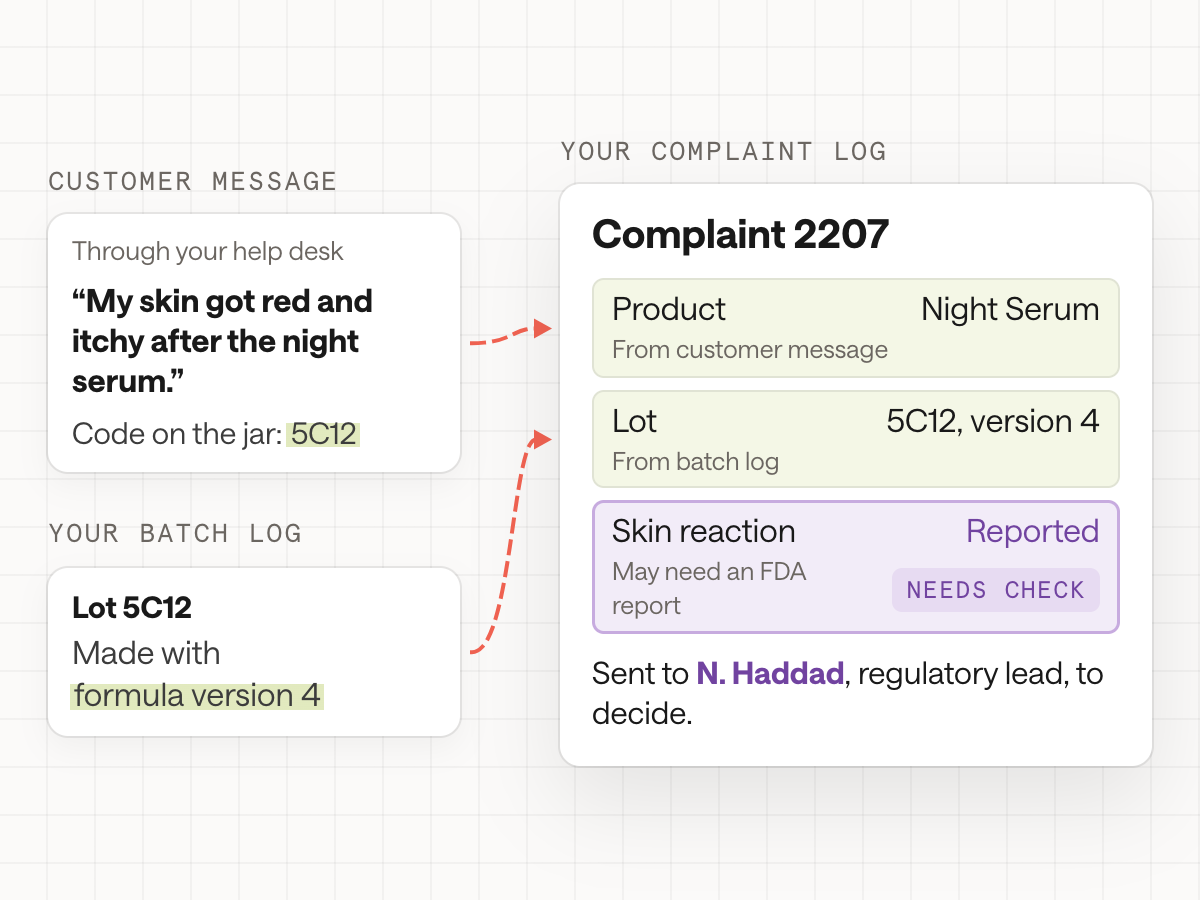
A customer reports a rash from the serum. Which batch was it?
The complaint lands in the help desk, the Shopify inbox, or a marketplace message. Customer service copies it into a spreadsheet, asks for the lot code on the bottom of the jar, searches the batch log, finds the formula version in a separate file, and emails the regulatory lead to ask whether it’s serious.
We build cosmetic complaint management that classifies incoming complaints, pulls out the product and lot, links them to the batch and formula version, and flags anything that may be a serious adverse event for immediate review. Your regulatory lead decides what it is and whether it gets reported.
Formula Changes & Safety Files
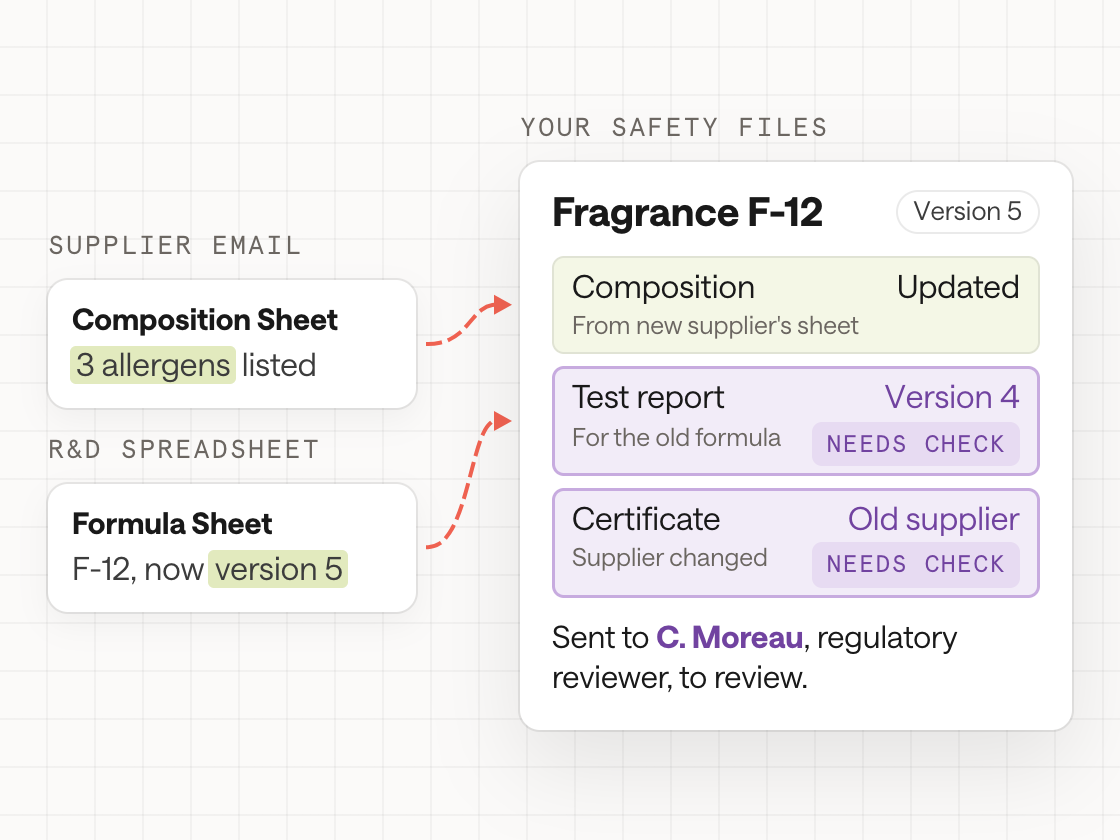
We changed the fragrance supplier. Is the safety file still current?
A new supplier’s fragrance has a different composition. R&D updates the formula in a spreadsheet and purchasing updates the ERP, but the safety folder still holds the old supplier’s documents and a test report for the previous version. Nobody notices until a retailer or an auditor asks for the file.
Formula versions, ingredient documents, and safety evidence stay linked, so a change to one flags the others for review. The system pulls supporting data out of supplier documents and points out what’s missing. Your regulatory reviewer decides whether the substantiation still holds.
Contract Manufacturing
Every brand client wants its paperwork its own way.
A contract manufacturer making lotions and cleansers for dozens of brands gets POs as PDFs and spreadsheets and keys them into the ERP. After each run, it sends every brand its batch documentation and CoA in that brand’s format, and someone retypes ingredient details from the batch record into each template.
We build tools that read POs in any format into the ERP, build each brand’s documents from your released batch data in their format, and draft replies to listing and document requests from your records. A person approves everything before it goes out.
Cosmetics software
Where AI and custom software fit in cosmetics & personal care
A lot of cosmetics manufacturing software is built for companies far larger than a growing brand or a regional contract manufacturer. The work that matters is usually smaller and more specific: connecting the formula, batch, safety, and complaint records you already keep, in cosmetic regulatory software or a shared folder, so one question takes one search.
Connected Product Records
Formula versions, ingredient lots, batch records, safety evidence, and complaints are linked into one history for each product. Ask about a SKU and see what went into it, which batches were made, and what supports its safety, with every source attached and one click away.
Complaint and Adverse Event Intake
Complaints from the help desk, email, Shopify, and marketplaces are classified, matched to product and lot, and checked for missing details. Anything that may be serious is flagged for your regulatory lead the moment it arrives, instead of at the end of the month.
Formula Change Follow-Through
When a formula, supplier, or ingredient changes, the linked safety evidence, supplier documents, labels, and product listings are flagged for review. Your regulatory reviewer sees what a change touches before the next batch is made.
Order Intake From Any Format
Brand-client POs, retailer orders, and reorder spreadsheets are read and entered in your ERP, with SKUs, fill sizes, and ship-to addresses matched to your records. Your order desk works the exceptions, like a new component or a changed label, instead of the typing.
Brand and Retailer Documents
CoAs, batch documentation, spec sheets, and ingredient statements are built from your released data in each brand’s or retailer’s format, with the current version every time. Nobody retypes a batch record into a template, and a person approves each one before it’s sent.
Registration and Listing Data
The details behind cosmetic facility registration and product listings, such as formula, ingredients, responsible person, and facility, are kept in one place and tied to the live formula version. When a formula changes, any listing that may need an update is flagged for your regulatory lead.







How we work with brands and contract manufacturers
We start by watching the work: how a complaint moves from the inbox to a decision, how a formula change reaches the batch record, and how a brand client gets its documents. That might be a morning in your plant or a screen share with the person who keeps the safety files. If you have sample batch records or a complaint log, you can send them ahead.
Then we think it through: which steps software can check, which need your regulatory lead’s judgment, and what to build first. You see a working prototype on sample data before anything touches your real records. Once your team approves it, we connect it to your systems and go live. We work within and around those systems, whether that’s NetSuite, Katana, or Zendesk, so your team keeps the tools it already knows.
Records & control
Faster answers can't blur who decided what.
Safety evidence, batch records, and complaint history are what let you stand behind a product when someone asks. New tools have to add to that history, keep clear who decided what, and stay light enough for a small team.
Work with the source of truth
Inventory and lots live in the ERP, formulas in your formulation file, and complaints in the help desk. We identify which system owns each record before automating around it, so you never end up with a sixth record that disagrees with the other five.
People decide and approve
AI reads, classifies, extracts, and flags. Your regulatory lead decides whether a complaint is a serious adverse event, whether a safety file still holds, and what goes to a brand or retailer. No tool we build makes those calls.
Sized for a small team
Many cosmetics companies have one person covering quality and regulatory work. We build around that reality: fewer screens, answers that cite their source, and flags that reach the right person instead of a dashboard nobody has time to check.
A permanent record of who signed off
Product records can be traced with a permanent record system: who did what, when, and who signed off, from a formula change to a complaint decision. Your team decides what goes into that record and who is allowed to see it.
The Modernization of Cosmetics Regulation Act of 2022 (MoCRA) expanded FDA’s oversight of cosmetics, including facility registration, product listing, serious adverse event reporting, and records that support safety substantiation, with some exemptions for small businesses. Which obligations apply depends on your products and your role. We don’t give regulatory advice. What we build supports your regulatory lead’s work.
FAQ
Cosmetic manufacturing software and MoCRA: common questions
What is MoCRA?
MoCRA is the Modernization of Cosmetics Regulation Act of 2022, the biggest update to US cosmetics law in decades. It gave FDA new authority over cosmetics, including facility registration, product listing, serious adverse event reporting, and safety substantiation records. Which parts apply to you depends on your products and your role, so check with your regulatory advisor.
What counts as a serious adverse event for a cosmetic?
For MoCRA adverse event reporting, a serious adverse event is one that results in outcomes such as death, hospitalization, significant disfigurement (including serious or persistent rashes), or a need for medical intervention to prevent one of those outcomes. Deciding whether a specific complaint qualifies stays with your regulatory lead. Our tools flag likely candidates early so nothing waits in an inbox.
What is cosmetic safety substantiation?
Safety substantiation is the evidence that a product is safe under its intended conditions of use: ingredient safety data, supplier documents, test reports, and expert review. It has to stay current when the formula or a supplier changes, which is why we link it to formula versions.
Do we need new cosmetic manufacturing software?
Usually not. Most cosmetics manufacturing teams, at a brand or a contract manufacturer, already have a cosmetic ERP or inventory system, a formula file, and a help desk. The hours go to connecting them by hand. We build that connecting layer around the systems you already run.
Does this work for contract manufacturers as well as brands?
Yes. Contract manufacturers usually start with order intake and brand documents. Brands usually start with complaint intake and connected product records. The building blocks are the same; the first project depends on where your hours go.
How do you handle complaints from Shopify and marketplaces?
We read complaints wherever they arrive, including the help desk, email, the Shopify inbox, and marketplace messages, and pull out the product, lot code, and symptoms into one queue. Missing details trigger a drafted follow-up, and a person approves every reply.
Can AI decide whether a complaint gets reported to FDA?
No. AI can classify complaints, link them to lots and formulas, and flag the ones that may be serious. Whether something is a serious adverse event, and whether it gets reported, stays with your regulatory lead.
You know AI could help. Let’s build it.
Bring us a task you have in mind, or just a hunch. We’ll help you find the right place to start and build it around the way your business works.