
AI + Custom Software for eCommerce
Turn more product data, customer intent, and operational complexity into revenue.
Commerce businesses already generate the information required to create better shopping experiences: product attributes, search behavior, orders, inventory, customer history, merchandising rules, support conversations, pricing, promotions, and performance data.
Think It First builds AI solutions for eCommerce, custom eCommerce software, product discovery systems, recommendation experiences, workflow automation, integrations, dashboards, and AI shopping tools that make that information more useful across the storefront and the operation behind it.
That helps customers find the right product faster, gives teams better control over catalogs and merchandising, and automates repetitive commerce work.

Common commerce problems
Common AI and automation opportunities in eCommerce
Converting a storefront takes systems, data, decisions, and manual work that its simple look hides.
AI Product Search & Discovery
Help shoppers describe what they need instead of guessing what your catalog calls it.
Traditional eCommerce search often depends on exact product names, attributes, filters, and terminology. That becomes a conversion problem when shoppers know the outcome they want but not the SKU, category, specification, or language required to find it.
We build AI search for eCommerce, semantic search, intelligent product search, guided selling, product finders, and conversational product discovery that connect natural-language intent to structured catalog data. A shopper can describe a problem, use case, compatibility requirement, style, specification, or preference and receive products that actually fit.
Personalization & Customer Intelligence
Make the next best product easier to find on every journey.
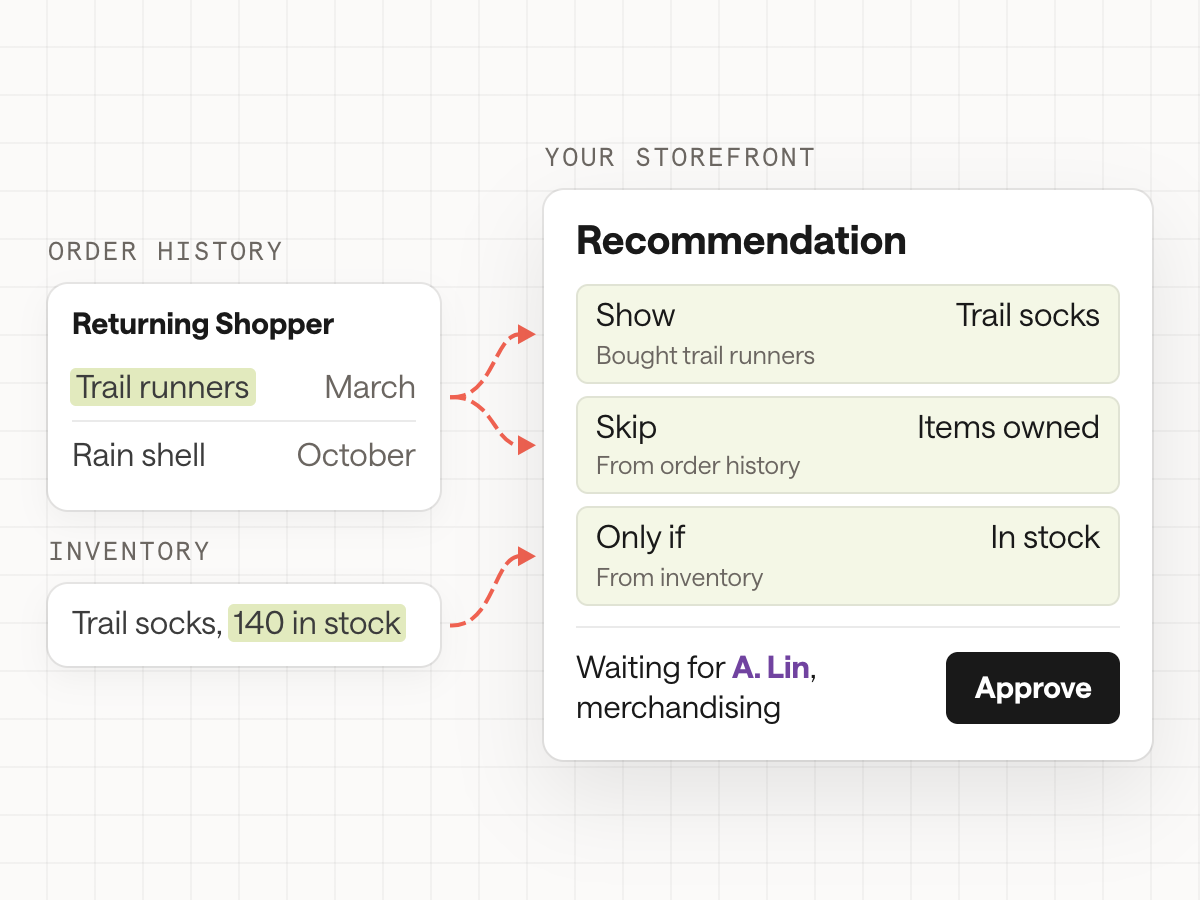
A catalog can contain thousands of possible paths to purchase. Customer behavior, product relationships, order history, affinities, inventory, margin, and merchandising priorities can help determine what a shopper should see next.
We build AI personalization for eCommerce, product recommendation systems, eCommerce recommendation engines, customer intelligence, merchandising logic, and AI shopping assistants that use available commerce data to make product discovery more relevant. The objective is commercial: reduce friction, improve conversion, create better cross-sell and upsell opportunities, and increase the value of each shopping journey.
Commerce Operations & Automation
Stop making your team reconcile the storefront with everything behind it.
Orders, inventory, customer records, product information, returns, fulfillment, pricing, marketplaces, support, and finance often live across separate systems. Staff become the integration layer: they export files, correct records, re-enter information, and answer questions the data could resolve on its own.
eCommerce automation, eCommerce workflow automation, order-management integration, ERP eCommerce integration, CRM eCommerce integration, and PIM integration can move information between systems, trigger the next step, surface exceptions, and keep customer-facing experiences aligned with operational reality.
Commerce digital transformation
Where AI and custom software fit in eCommerce
Product discovery is becoming semantic and conversational, personalization is becoming more dynamic, and AI agents are beginning to research, compare, recommend, and transact on behalf of shoppers. The opportunity is to identify where better intelligence can increase revenue, remove friction, reduce manual commerce work, or make the product catalog more useful to both people and machines.
AI Search, Product Discovery, and Guided Selling
Build eCommerce product discovery, semantic search, natural-language search, product finders, guided selling software, and AI shopping assistants around the way customers actually describe what they need. Search experiences can combine product attributes, compatibility, inventory, merchandising priorities, customer context, and behavioral signals to improve relevance and spare shoppers endless filters.
Recommendations, Personalization, and Merchandising Intelligence
Use customer behavior and catalog data to power AI product recommendations, eCommerce personalization, recommendation systems, intelligent merchandising, cross-sell, upsell, bundles, and contextual offers. The system can support merchant rules and business priorities rather than treating personalization as an opaque black box.
Catalog, Product Data, and AI Visibility
Large or technical catalogs create their own operational and discovery problems. eCommerce catalog management, product information management, catalog automation, product data enrichment, and AI-ready product content can improve how attributes, specifications, relationships, descriptions, and structured product information are maintained and exposed. Better product data supports storefront search today and makes catalogs easier for AI-led shopping experiences to understand tomorrow.
Commerce Operations & Customer Service Automation
Automate the repetitive work surrounding orders, returns, fulfillment, customer questions, product information, status updates, and exception handling. eCommerce process automation, customer service AI, customer support automation, order-status automation, and AI assistants can resolve routine work, gather context for staff, and escalate the situations that actually require human judgment.
Commerce, ERP, CRM, PIM, and OMS Integration
A commerce experience is only as useful as the systems behind it. We build eCommerce system integration, eCommerce API integration, eCommerce data integration, ERP eCommerce integration, CRM eCommerce integration, PIM eCommerce integration, and order-management integration across storefronts, back-office platforms, customer systems, product-data tools, and custom applications.
Custom Commerce Applications, Portals, and Intelligence
Some revenue opportunities belong outside a standard storefront. Our eCommerce software development work can include B2B eCommerce portals, dealer and distributor experiences, customer self-service portals, product configurators, custom checkout or account workflows, eCommerce analytics dashboards, and commerce business intelligence built around the operating model the business actually has.















How we work with eCommerce organizations
Commerce problems usually run through the whole system behind the storefront. A weak search experience may begin with incomplete product attributes. A customer-service problem may actually be an order-data problem. A merchandising bottleneck may come from the PIM. A personalization idea may require customer, catalog, inventory, and behavioral data that currently live in four different places. We work within and around all four, on stores running Shopify Plus or Adobe Commerce with orders landing in NetSuite.
We start by following the customer and the data through the full commerce environment. Discovery can include storefront and search analysis, catalog and product-data review, merchandising workflows, customer-service processes, order and fulfillment flows, analytics, platform architecture, integrations, and the back-office systems supporting the experience.
Then we determine what should be improved inside the current platform, what needs to be connected, and where a custom eCommerce development, AI, automation, or data layer adds the most value.
Revenue, data, and control
Better automation still has to protect the buying experience.
Commerce systems make decisions at scale. Search ranking, recommendations, pricing, inventory, customer data, product information, order status, and automated support can directly affect conversion, customer trust, and revenue. New intelligence should make those systems more useful and keep the customer experience controlled.
Keep product and inventory data grounded
AI search, recommendations, assistants, and customer-service tools should work from current catalog, pricing, availability, compatibility, and policy information. We design around the systems that remain authoritative so customer-facing intelligence does not invent product facts or recommend something the business cannot actually sell.
Preserve merchandising control
Machine learning can improve relevance while the merchant stays in charge. Search, recommendation, personalization, and guided-selling systems can incorporate business rules, exclusions, priorities, inventory considerations, and promotional strategy so automation supports commercial judgment rather than silently overriding it.
Respect customer data boundaries
Personalization and AI assistants can require customer, behavioral, transactional, and account data. We design integrations and applications around appropriate permissions, data minimization, system boundaries, and the organization's existing privacy and security requirements.
Measure what changes revenue
Search engagement, zero-result behavior, conversion, average order value, assisted revenue, support volume, workflow time, and other relevant outcomes should inform whether a new experience is actually improving the business.
Product catalogs, structured attributes, inventory, pricing, and transaction capabilities may also need to become legible to external AI agents and conversational shopping experiences. We design for today’s customer journey and keep the commerce architecture ready for AI-led product discovery.
FAQ
AI for eCommerce: common questions
What is AI product search for eCommerce?
AI product search lets shoppers describe what they need in their own words (a use case, a compatibility requirement, or a style) instead of guessing the exact product name or filter. Semantic search connects that intent to structured catalog data, attributes, and inventory, so the results actually fit. Your merchandising rules still apply, and results come from current catalog and availability data, so the system doesn’t invent product facts or recommend something you can’t sell.
What is eCommerce product intelligence software?
Product intelligence uses catalog, behavior, order, inventory, and margin data to decide what shoppers see and what your team acts on. In practice, it can power product recommendations, cross-sell and upsell, bundles, search reporting such as zero-result queries, and eCommerce analytics dashboards. Think It First builds it around your platform and merchant rules, so the merchandising team can tune the logic instead of treating personalization as a black box.
Does AI search work if our product data is incomplete?
Weak search often starts with incomplete attributes, so we look at the catalog early. Product data enrichment, catalog automation, and PIM integration can fill gaps, structure specifications, and keep descriptions consistent across systems. That work pays off twice: storefront search gets more relevant, and the catalog becomes easier for AI shopping assistants and external AI agents to understand. You can start with the catalog you have, after a clear look at it.
Can AI answer order status and customer service questions?
Yes, for the routine ones. Many support tickets are order questions the underlying data could already answer. Customer service AI and order-status automation can look up orders, returns, and shipping status, resolve routine questions, gather context for staff, and escalate the cases that need human judgment. It works best when the storefront, order management, ERP, and shipping data are connected, so integration is usually part of the project.
Do we have to replatform to add AI to our store?
Usually not. We build around the platform you already run, such as Shopify Plus, Adobe Commerce / Magento, BigCommerce, Salesforce Commerce Cloud, WooCommerce, or a custom storefront. Discovery decides what to improve inside the current platform, what to connect, and where a custom layer adds the most value. Replatforming can be expensive and disruptive, and it’s rarely the first answer when the existing store works.
Can you build B2B eCommerce portals?
Yes. Some revenue opportunities fit outside a standard storefront. We build B2B eCommerce portals, dealer and distributor experiences, customer self-service portals, product configurators, and custom account workflows connected to your ERP and catalog. If a B2B customer still emails a spreadsheet to place an order, that order can be read and written into your systems, with anything unusual sent to the person who owns the account.
You know AI could help. Let’s build it.
Bring us a task you have in mind, or just a hunch. We’ll help you find the right place to start and build it around the way your business works.