
AI + Custom Software for Professional Services
Make more of your firm's expertise usable.
Your most expensive people should not spend their day searching old folders, rebuilding proposals, chasing project updates, assembling reports, or figuring out who knows what.
Think It First builds AI for professional services, custom professional services software, knowledge systems, proposal automation, workflow automation, integrations, dashboards, and client-facing digital tools that make expertise easier to find, reuse, coordinate, and scale.
The goal is to redesign the work surrounding professional judgment, so more of your team's time can go toward clients, decisions, analysis, relationships, and the work people actually hired the firm to do.

Common firm problems
Common AI and automation opportunities in professional services
When expertise is the product, administrative friction has an unusually high opportunity cost.
Proposal, RFP, and Pursuit Automation
Your firm has answered this before. The proposal team should not have to rediscover the answer.
RFPs, proposals, pitches, SOWs, credentials, bios, case studies, pricing context, and prior engagement examples often live across Microsoft 365, CRM records, shared drives, and individual memory. Every new pursuit can trigger another round of searching, copying, rewriting, formatting, and chasing subject-matter experts.
We build proposal automation for professional services, RFP automation, proposal knowledge systems, AI-assisted response workflows, and pursuit intelligence that retrieve approved material, surface relevant experience, assemble first drafts, coordinate inputs, and preserve human review. Senior people spend less time reconstructing the firm's history and more time deciding how to win the work.
Resource, Project, and Firm Intelligence
Know who should work on what before another staffing meeting becomes the system.
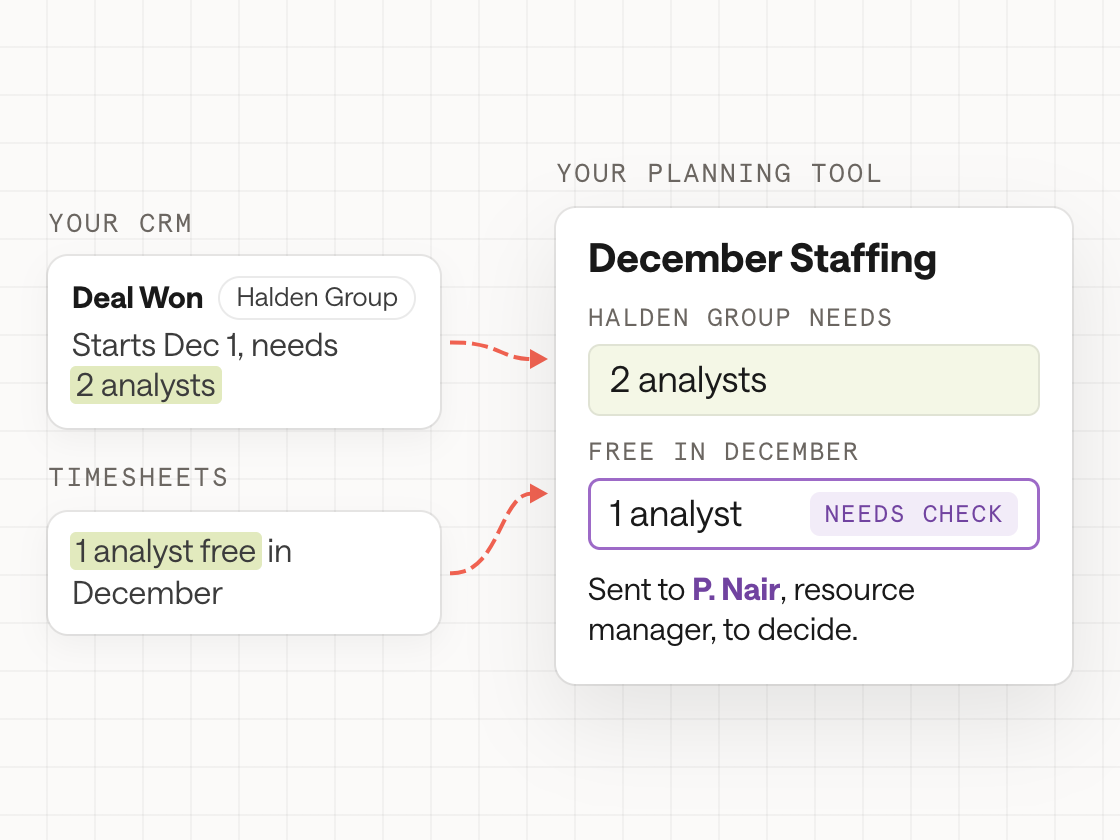
Pipeline, skills, availability, utilization, project economics, deadlines, workload, client commitments, and historical performance often live in separate systems or in the heads of the people who handle staffing. That makes resource planning reactive and can hide the connection between a sales decision, a staffing constraint, a project overrun, and margin.
We build professional services resource planning, capacity planning, utilization dashboards, project intelligence, staffing tools, and professional services analytics that connect the information required to make better operating decisions. The result is clearer visibility into where expertise is available, where delivery is at risk, and where the firm has room to grow.
Institutional Knowledge & Client Delivery
The firm knows the answer. Finding the person, project, or file that contains it is the problem.
Expertise accumulates across deliverables, research, methodologies, meeting notes, project files, SOWs, client correspondence, presentations, and the people who created them. Folders hold documents, and the relationships between what the firm learned, who knows it, where it was used, and what happened next are easy to lose.
We build professional services knowledge management, enterprise search, AI knowledge bases, semantic search, document intelligence, and client-delivery automation around the firm's actual sources. Teams can find prior thinking, compare relevant work, prepare project summaries, reuse approved material, and bring institutional memory into new engagements, with the firm’s approved sources as the source of truth.
Professional services digital transformation
Where AI and custom software fit in professional services
Professional services firms need better systems because valuable knowledge and expensive human judgment are surrounded by enormous amounts of coordination. AI can retrieve context, compare documents, prepare drafts, summarize project records, classify requests, identify patterns, and recommend next steps. Custom software can connect that intelligence to the systems where sales, staffing, delivery, finance, and client work already happen.
Proposal, RFP, and Business Development Intelligence
Build AI proposal workflows, RFP response automation, pursuit management tools, proposal content libraries, experience search, and business-development intelligence around approved firm knowledge. Systems can parse requirements, retrieve relevant answers and credentials, surface similar engagements, coordinate contributors, and prepare reviewable responses while BD and subject-matter experts retain control over positioning and commitments.
Firm Knowledge, Enterprise Search, and Institutional Memory
Create professional services knowledge bases, enterprise search, semantic search, AI knowledge management, expertise discovery, and document intelligence across approved repositories. Search can connect projects, people, deliverables, methodologies, meeting notes, research, and prior decisions so the firm's accumulated experience becomes easier to find and reuse.
Client Delivery & Document Automation
Reduce the administrative work surrounding the engagement. Professional services workflow automation, document automation, project summary generation, client reporting automation, meeting intelligence, research workflows, and deliverable support can gather project context, prepare first passes, structure recurring outputs, and surface missing information while the professionals responsible for the work remain accountable for the final product.
Resource, Capacity, and Utilization Intelligence
Connect skills, availability, pipeline, assignments, utilization, deadlines, and project requirements through professional services resource management, capacity planning, staffing intelligence, utilization analytics, and workforce planning. Instead of manually reconciling who is free with who is qualified, leaders can see constraints earlier and make staffing decisions with better context.
CRM, PSA, Finance, and Project System Integration
Professional services operations often span CRM, professional services automation software, project management, finance, time tracking, HR, document management, and collaboration platforms. We build professional services system integration, PSA integration, CRM integration, ERP integration, APIs, middleware, and data workflows that connect those environments while every system that already works stays in place.
Custom Client Portals, Internal Applications, and Firm Intelligence
Not every service-delivery model fits an off-the-shelf PSA or project platform. Our professional services software development work can include client portals, secure document experiences, project dashboards, internal workflow applications, expertise directories, research tools, account intelligence, management reporting, and custom operating systems built around the way the firm actually delivers work.













How we work with professional services firms
The real bottleneck often sits behind the visible one. A proposal problem may begin with fragmented case-study data. A utilization problem may begin with pipeline visibility. A knowledge problem may actually be a permissions problem. A project-management problem may come from information moving between CRM, PSA, finance, and delivery systems too late. We work within and around those systems, including Microsoft 365, SharePoint, and NetSuite, rather than asking your people to give up the platforms they already rely on.
We start by following the work across the firm. Discovery can include sales and pursuit workflows, project intake, staffing, knowledge repositories, document production, client delivery, reporting, time and financial processes, collaboration tools, and the handoffs between departments.
For firms within traveling distance, we can work on site, observe the workflow directly, and hold working sessions with the people doing the job. Then we determine what should be automated, what needs better retrieval, which systems should exchange data, where human approval matters, and where a custom professional services application or AI layer creates the most value.
Knowledge, accountability, and control
The system can prepare the work. Your experts still own the judgment.
Professional services firms are trusted because people are accountable for the advice, analysis, commitments, and deliverables they produce. AI should increase the amount of context available to those people and reduce the administrative effort surrounding their decisions, while showing where each answer came from.
Work from approved firm knowledge
Retrieval, drafting, and automation should use defined repositories and authoritative project data. We design systems around approved sources, permissions, document versions, and engagement boundaries so internal knowledge becomes more accessible to the right people.
Make important outputs reviewable
Proposals, client deliverables, recommendations, financial interpretations, and other consequential outputs need accountable owners. AI can retrieve, summarize, compare, and draft; the appropriate professional can verify the evidence and approve what leaves the firm.
Respect client and matter boundaries
Professional services organizations may hold confidential client information across many projects and teams. Search, automation, and institutional-memory systems should preserve access controls and prevent convenience from collapsing boundaries that exist for a reason.
Measure capacity
The useful question is whether proposal throughput improved, project administration declined, staffing became faster, knowledge became easier to retrieve, utilization improved, or more professional time became available for valuable client work.
Firms can use the same underlying knowledge and operating data to improve delivery, create more repeatable service models, and support more work without assuming that revenue must scale linearly with administrative headcount.
FAQ
AI for professional services: common questions
How is AI used in professional services firms?
Mostly in the work around the work. AI can retrieve approved proposal content, surface similar engagements, summarize project records, draft client updates, classify incoming requests, and match skills with availability for staffing. The professional judgment stays with your people. The aim is for a senior consultant to spend less time searching old decks and rebuilding status reports, and more time on clients, analysis, and the work the firm was hired to do.
Can AI automate RFP document processing and proposal responses?
It can handle much of the assembly. RFP automation can parse an incoming request’s requirements, pull approved answers, bios, credentials, and case studies from your library, surface similar past pursuits, and prepare a first draft for review. It can also track which subject-matter experts still owe input. Your business-development lead and those experts still decide positioning and commitments, and nothing leaves the firm without their approval.
How do you keep confidential client information separated in an AI knowledge system?
Search and automation are built to respect the access controls and client or matter boundaries the firm already has. We design around approved repositories, permissions, document versions, and engagement boundaries, so people retrieve only what they’re already allowed to see. A knowledge problem is sometimes really a permissions problem, so discovery looks at both before anything is connected.
Can you connect our PSA, CRM, and finance systems?
Yes. Professional services operations often span CRM, PSA software, project management, time tracking, finance, HR, and document management. We build PSA integration, CRM integration, APIs, and data workflows that move information between them while systems that already work, such as Certinia, Kantata, Deltek, NetSuite, or Microsoft 365, stay in place. Then a sales decision, a staffing constraint, and project margin can be seen together.
Can AI help with resource planning and utilization?
It can bring the inputs together. Skills, availability, pipeline, assignments, deadlines, and utilization usually sit in separate systems or in the heads of whoever handles staffing. We build resource planning tools, capacity views, and utilization dashboards that connect them, so leaders see constraints earlier and can match qualified people to the work before another staffing meeting becomes the system. The staffing decisions stay with the people who make them today.
How do we know whether AI is improving the firm?
We agree on the outcome before building. For a firm, that’s usually proposal throughput, time spent on project administration, how quickly staffing decisions get made, how easily people find prior work, or how much professional time goes back to client work. The number of prompts the firm sends tells you very little. If a measure isn’t moving, we look at the workflow again rather than counting AI activity as success.
You know AI could help. Let’s build it.
Bring us a task you have in mind, or just a hunch. We’ll help you find the right place to start and build it around the way your business works.